
“Justice delayed is justice denied” — this is a phrase we frequently hear in society. When an injustice is done to a person, if they do not receive justice at the right time, then no matter how great the subsequent judgment is, it holds no value. Just as serving a grand feast to a starving person after they have lost their life is of no use, a verdict delivered after years of wandering around courts and after life itself has ended is equally meaningless!
Structural Flaws
There are some bitter truths behind why it takes years or even decades for a civil or criminal case to conclude in India. Primarily, compared to the mountains of cases piling up in courts, the number of judges available to hear them is extremely low, which has become a major curse for the system.
In addition to this, in many cases, the accused intentionally delay the trial using various tactics. Specifically, even after the police file a charge sheet, years pass just for court notices (Summons) to be served to the accused. Due to the accused seeking adjournments without appearing in court or evading appearances altogether, trials stall at the very initial stage, and cases move at a snail’s pace.
Delay is a Curse for Victims… A Boon for the Accused!
There is no doubt that due to the delay in cases, it is the victims who suffer much more than the accused. Especially for the elderly and retired employees, who lose their lifelong hard-earned savings or rights, having to run around courts instead of living peacefully in their old age turns into a living hell. Due to this physical exertion, they not only deteriorate physically but also undergo severe mental agony.
Furthermore, because a case drags on for decades, over time, the memory of witnesses fades or they pass away, weakening the evidence, which indirectly benefits the wrongdoer. Added to all of this, traveling to court for every hearing and bearing legal expenses and lawyer fees damages the financial condition of poor and middle-class families, becoming a massive burden.
Speedy Trial: This is Our Fundamental Right!
According to our Constitution, getting justice quickly is not just a wish… it is the right of every citizen! The Supreme Court has clarified that under Article 21 of the Constitution (Right to Life and Personal Liberty), everyone has the “Right to Speedy Trial” (the Hussainara Khatoon case judgment is a prime example of this). Justice is not meant only to protect the rights of the accused, but also to provide timely relief to the victim!
So, what should a victim do if a case in the lower courts (Trial Courts) gets stalled in the exact same place for years, simply because the accused is not showing up or for some other reason? Should they just sit back and lament? No!
The victim can approach the High Court through a lawyer. Under Section 482 of the Criminal Procedure Code (CrPC) (Section 528 of the current BNSS), an “Early Disposal Petition” (a petition for speedy resolution of the case) can be filed in the High Court.
Under what circumstances can ‘Early Disposal’ be sought in the High Court under Section 482 of the Criminal Procedure Code (CrPC) (Section 528 of the current BNSS)?
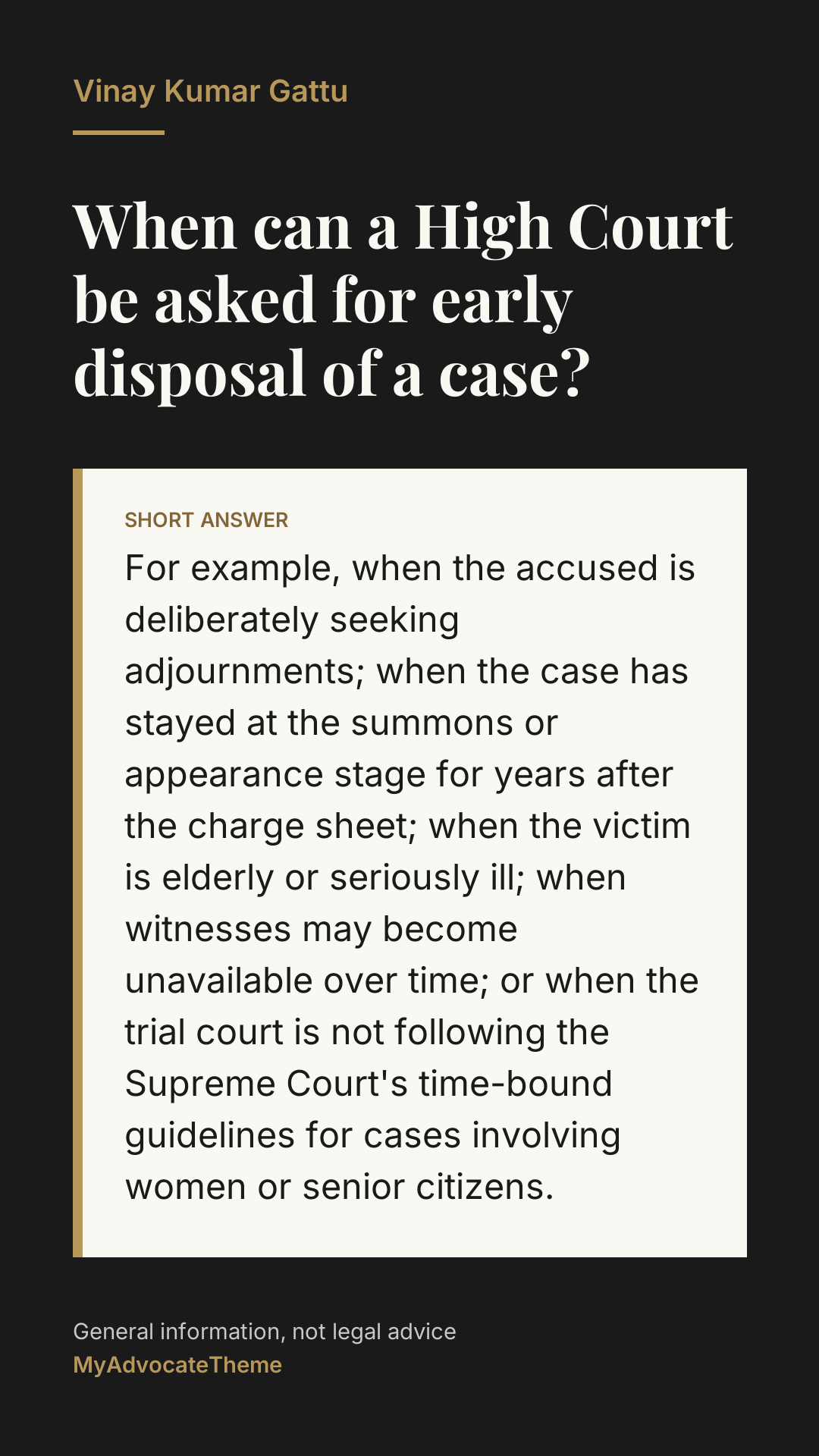
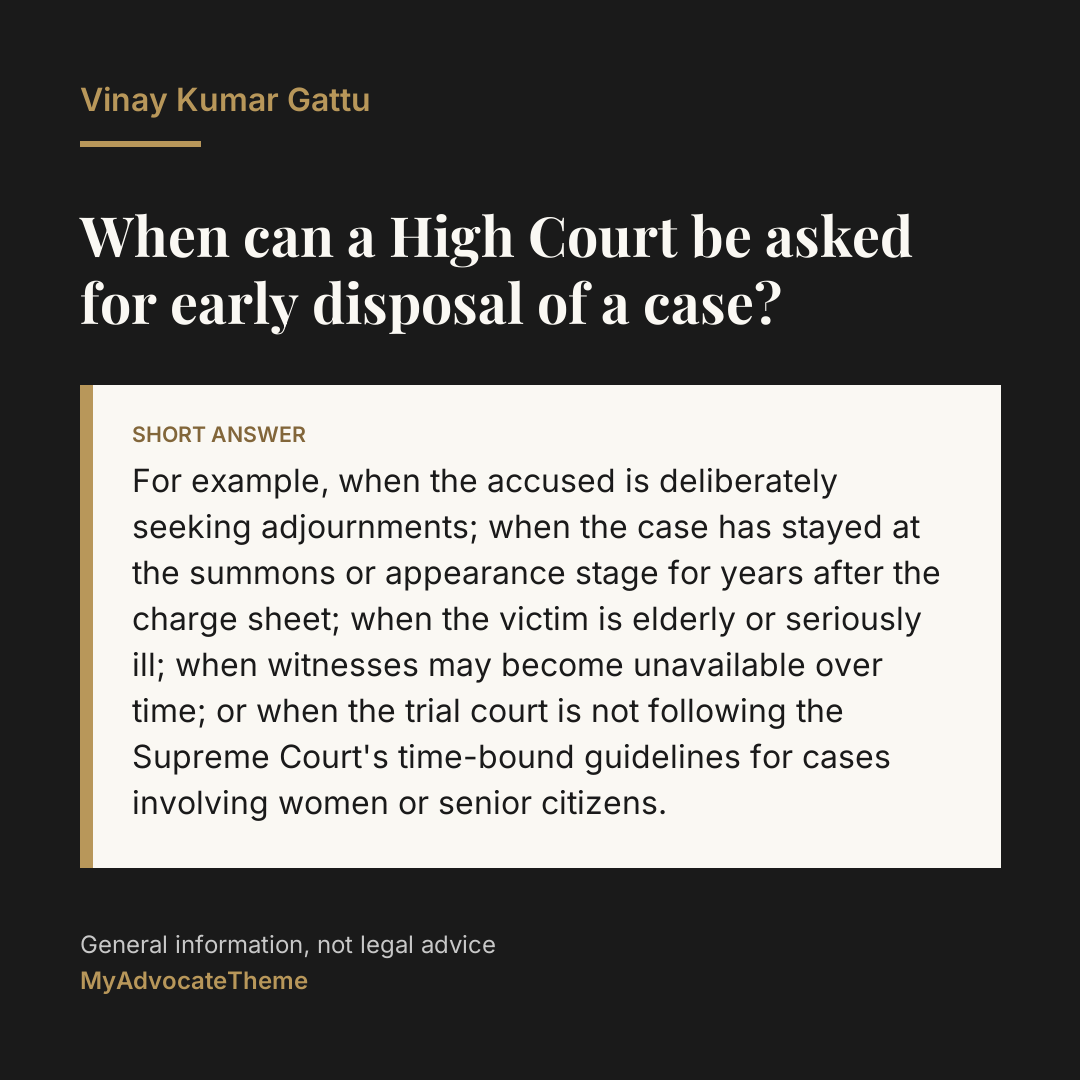
There must be strong reasons to file an Early Disposal Petition in the High Court. A victim is fully eligible to seek a ‘speedy resolution’ under the following circumstances:
- When the accused is intentionally seeking adjournments to obstruct and delay the trial.
- When, even after the charge sheet is filed, the case remains stalled in the exact same place for years merely for the purpose of serving summons or securing the appearance of the accused (Summons / Appearance Stage).
- When the victims are elderly or suffering from severe illnesses.
- When the case is dragging on so excessively that there is a high risk of witnesses becoming unavailable or passing away over time.
- When the lower courts fail to follow the time-bound guidelines issued by the Supreme Court regarding cases involving women or senior citizens.
Justice Not Received in Time… is Equivalent to Injustice!
For a common man to have faith in the judicial system, judgments must be delivered at the right time. A verdict delivered after years of running around courts and after a person has passed away offers absolutely no solace to the victim. Therefore, the situation where elderly victims have to wait for the rest of their lives must change. Everyone must recognize that justice not delivered in time is equivalent to committing another injustice against the victim.

Comments