No. The Supreme Court held that a child protected under Section 16(1) or Section 16(2) of the Hindu Marriage Act, 1955 does not become a coparcener by birth in a Mitakshara Hindu joint family. Under Section 16(3), their property rights are confined to the property of their parents and do not extend to the property of any person other than the parents.
Yes, in respect of the property of their parents, provided the conditions of Section 16(1) or Section 16(2) of the Hindu Marriage Act, 1955 are met. The Supreme Court held that such a child is conferred statutory legitimacy and can inherit a share in the parent's property, including the parent's share ascertained through a notional partition upon death under Section 6(3) of the Hindu Succession Act, 1956.
Under Article 15(6)(b), the State is enabled to make special provisions, including up to 10% reservation for EWS, for admission to educational institutions—including private educational institutions, whether aided or unaided by the State—except minority educational institutions covered under Article 30(1). The Constitution Bench held that this does not breach the basic structure of the Constitution.
The majority of the Constitution Bench held that the 50% reservation cap is not an inflexible or unamendable part of the Constitution's basic structure. Furthermore, the Court observed that earlier rulings on the 50% ceiling applied to reservations under Articles 15(4), 15(5), and 16(4), so providing up to 10% reservation for EWS does not breach the basic structure.
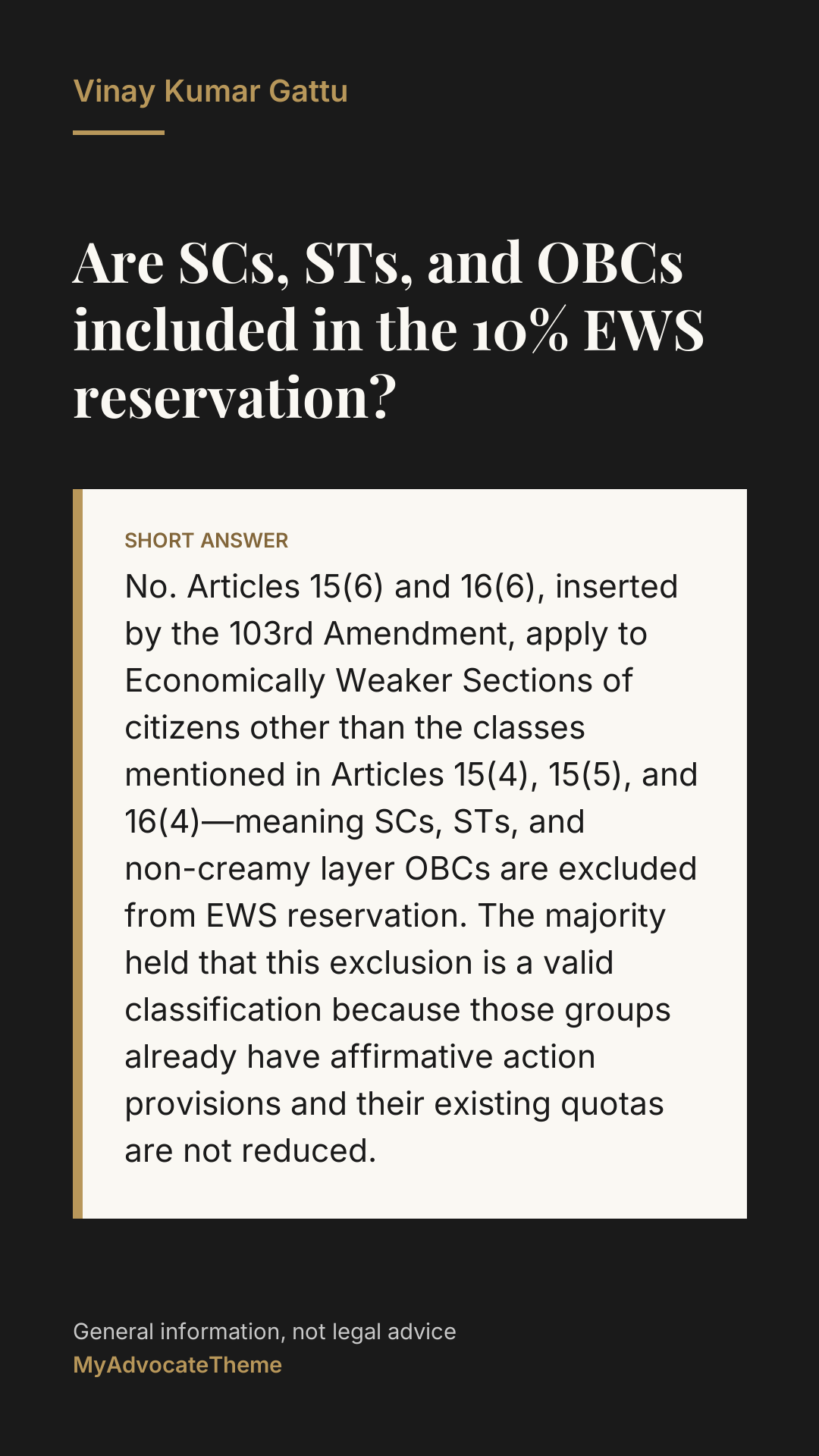
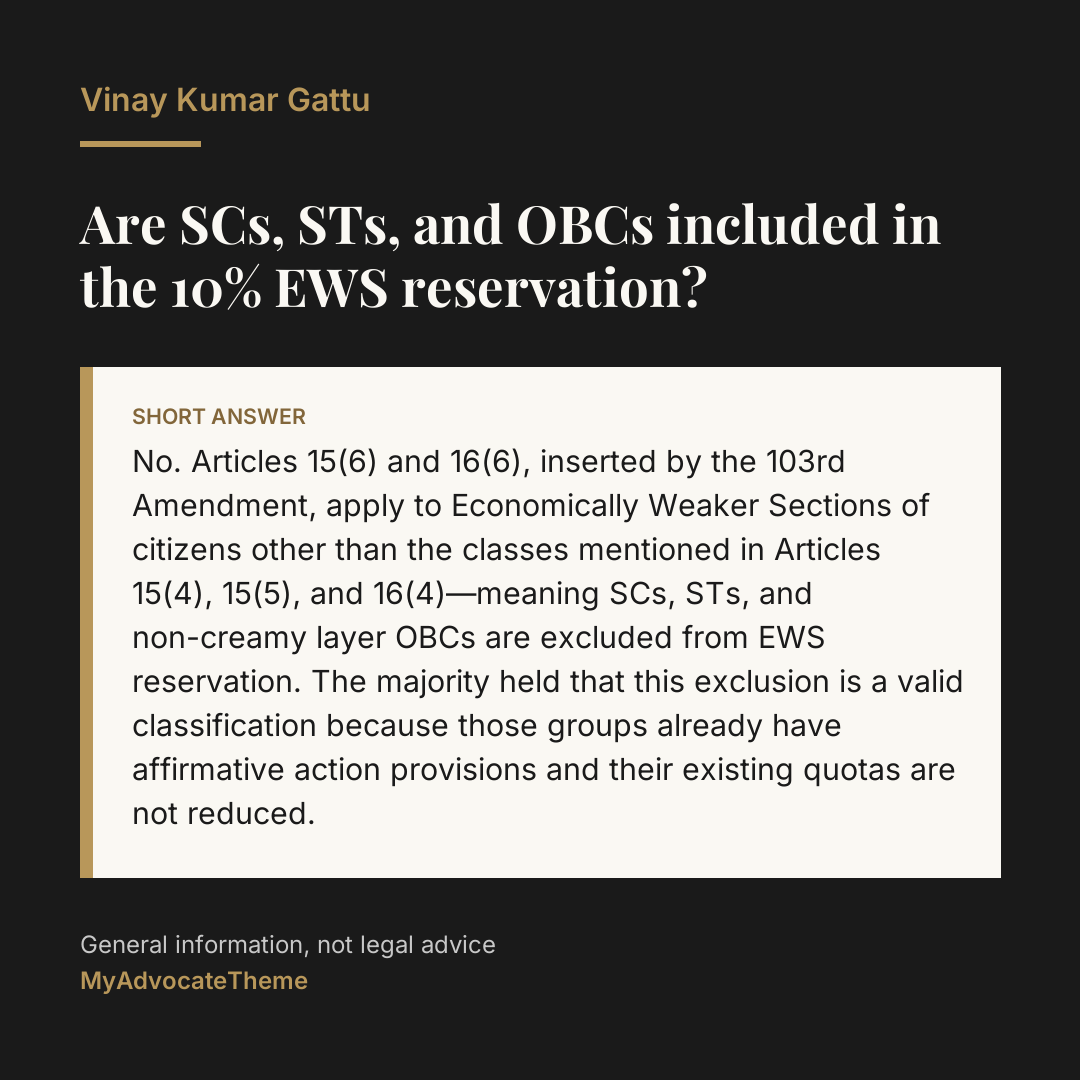
No. Articles 15(6) and 16(6), inserted by the 103rd Amendment, apply to Economically Weaker Sections of citizens other than the classes mentioned in Articles 15(4), 15(5), and 16(4)—meaning SCs, STs, and non-creamy layer OBCs are excluded from EWS reservation. The majority held that this exclusion is a valid classification because those groups already have affirmative action provisions and their existing quotas are not reduced.
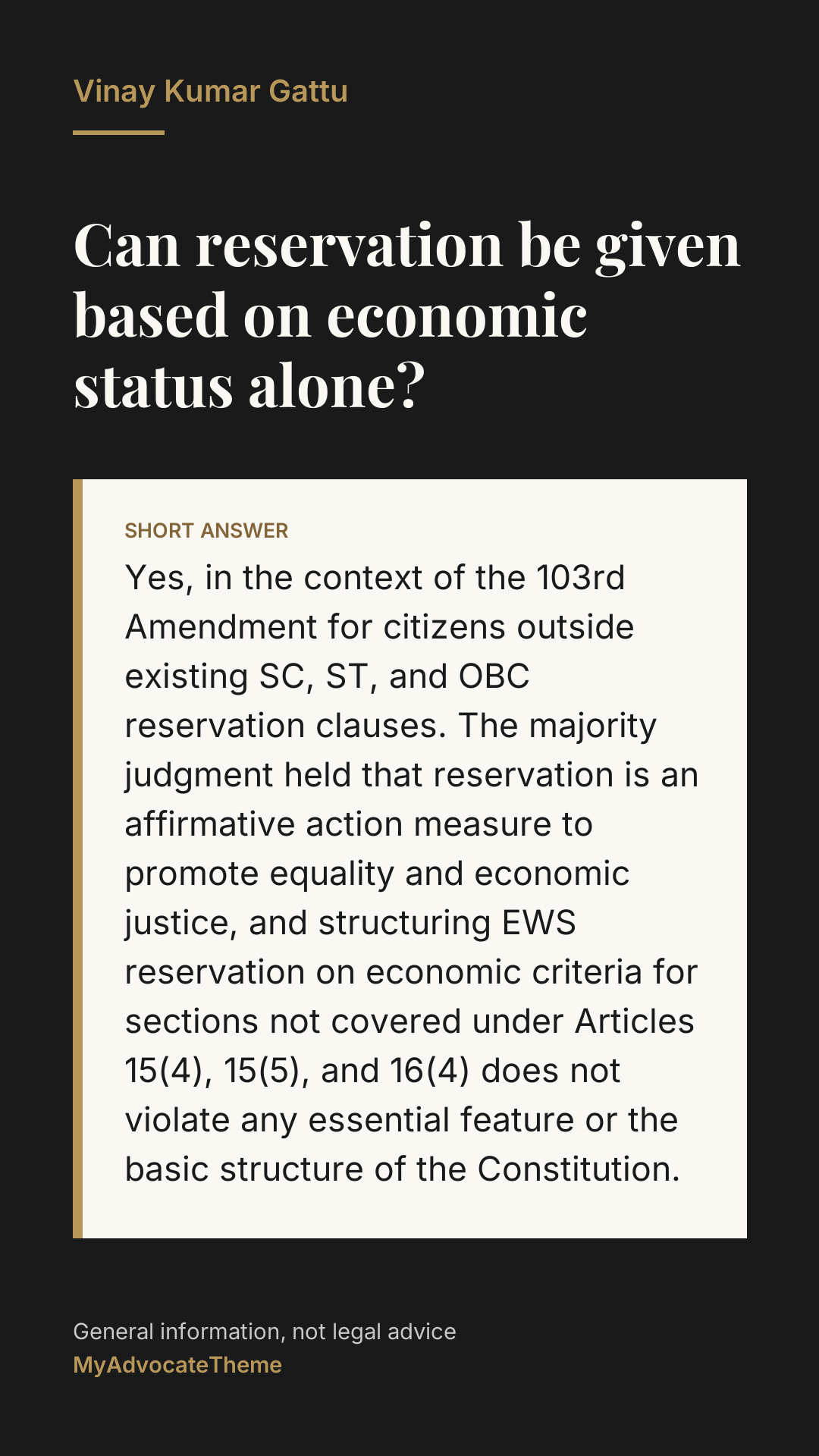
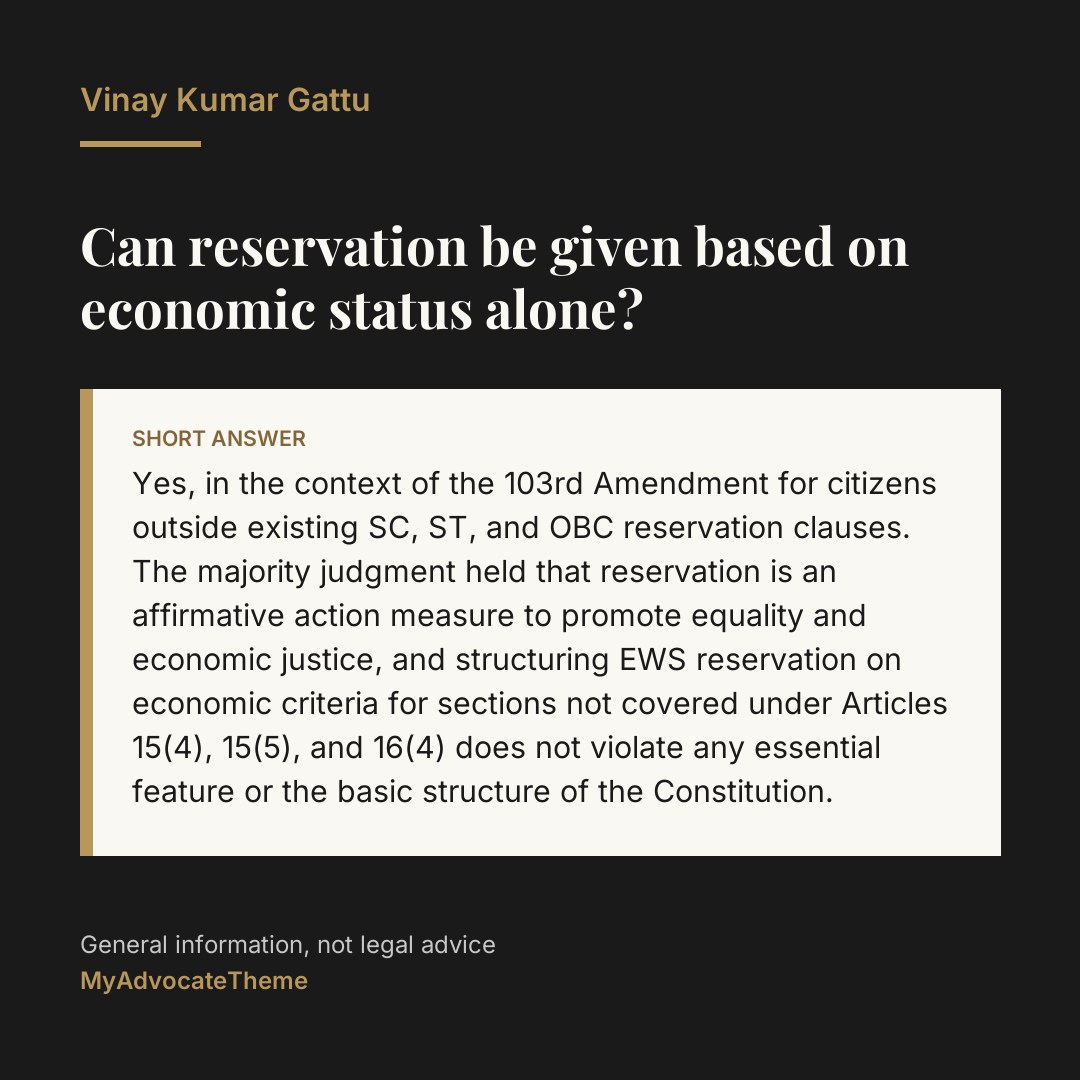
Yes, in the context of the 103rd Amendment for citizens outside existing SC, ST, and OBC reservation clauses. The majority judgment held that reservation is an affirmative action measure to promote equality and economic justice, and structuring EWS reservation on economic criteria for sections not covered under Articles 15(4), 15(5), and 16(4) does not violate any essential feature or the basic structure of the Constitution.