More languages

Machine translation by Google, for convenience only. It may contain errors; the English and Telugu pages are the reliable versions.

Practice area

Civil, Commercial & Property Litigation

Representation in property injunctions, specific performance, title disputes, Section 22-A / revenue matters, recovery suits, and contractual litigation.

Common situations

  • Is someone interfering with your possession of land or a house?
  • Has a seller refused to complete a sale after an agreement?
  • Is your property wrongly listed as prohibited under Section 22-A?
  • Does someone owe you money under a contract or a loan?

If one of these sounds like your matter, a short consultation can clarify your options.

Questions answered

All questions

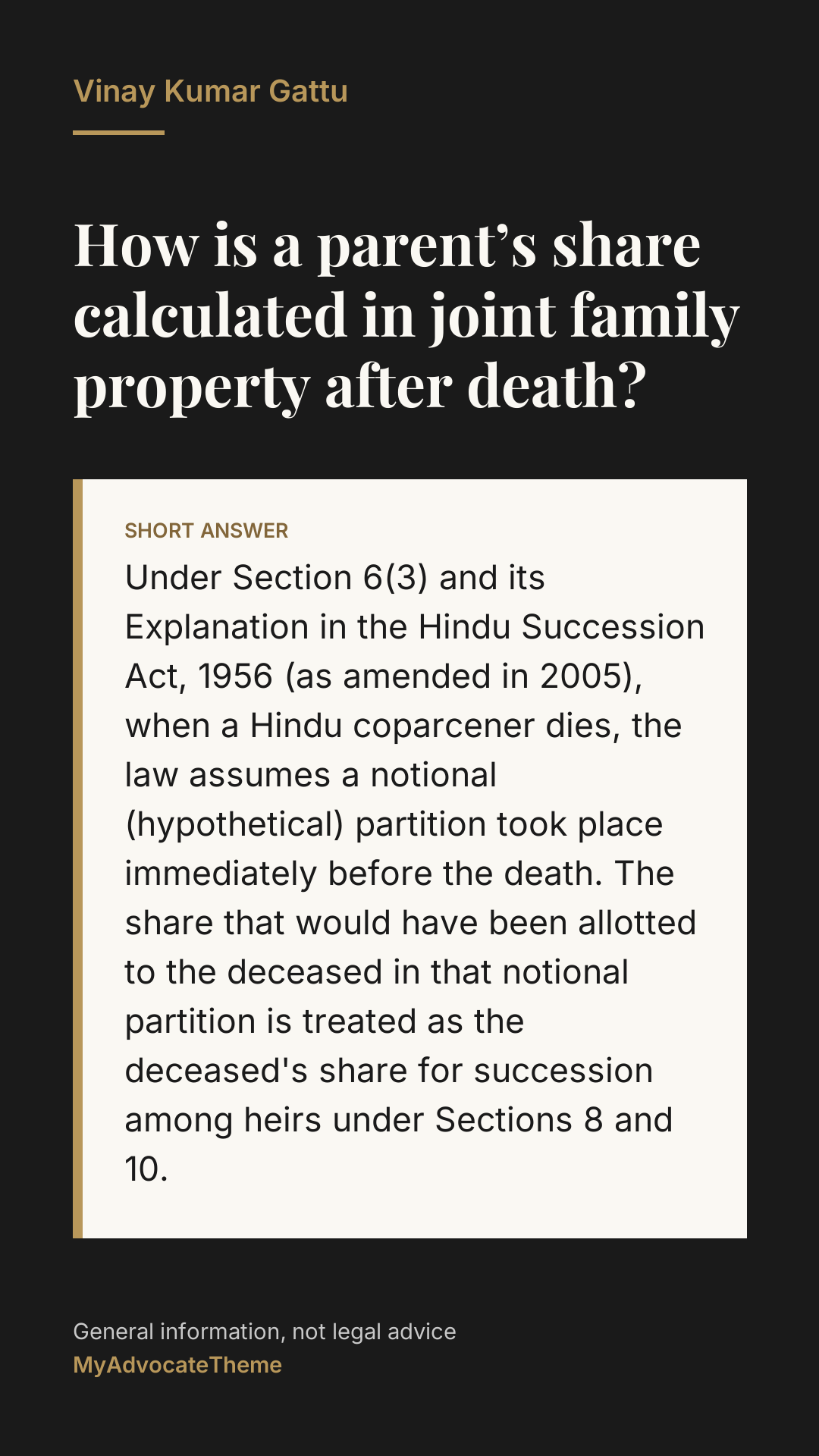
How is a parent’s share calculated in joint family property after death?

Under Section 6(3) and its Explanation in the Hindu Succession Act, 1956 (as amended in 2005), when a Hindu coparcener dies, the law assumes a notional (hypothetical) partition took place immediately before the death. The share that would have been allotted to the deceased in that notional partition is treated as the deceased's share for succession among heirs under Sections 8 and 10.

Does a child from a void marriage become a coparcener in joint family property?

No. The Supreme Court held that a child protected under Section 16(1) or Section 16(2) of the Hindu Marriage Act, 1955 does not become a coparcener by birth in a Mitakshara Hindu joint family. Under Section 16(3), their property rights are confined to the property of their parents and do not extend to the property of any person other than the parents.

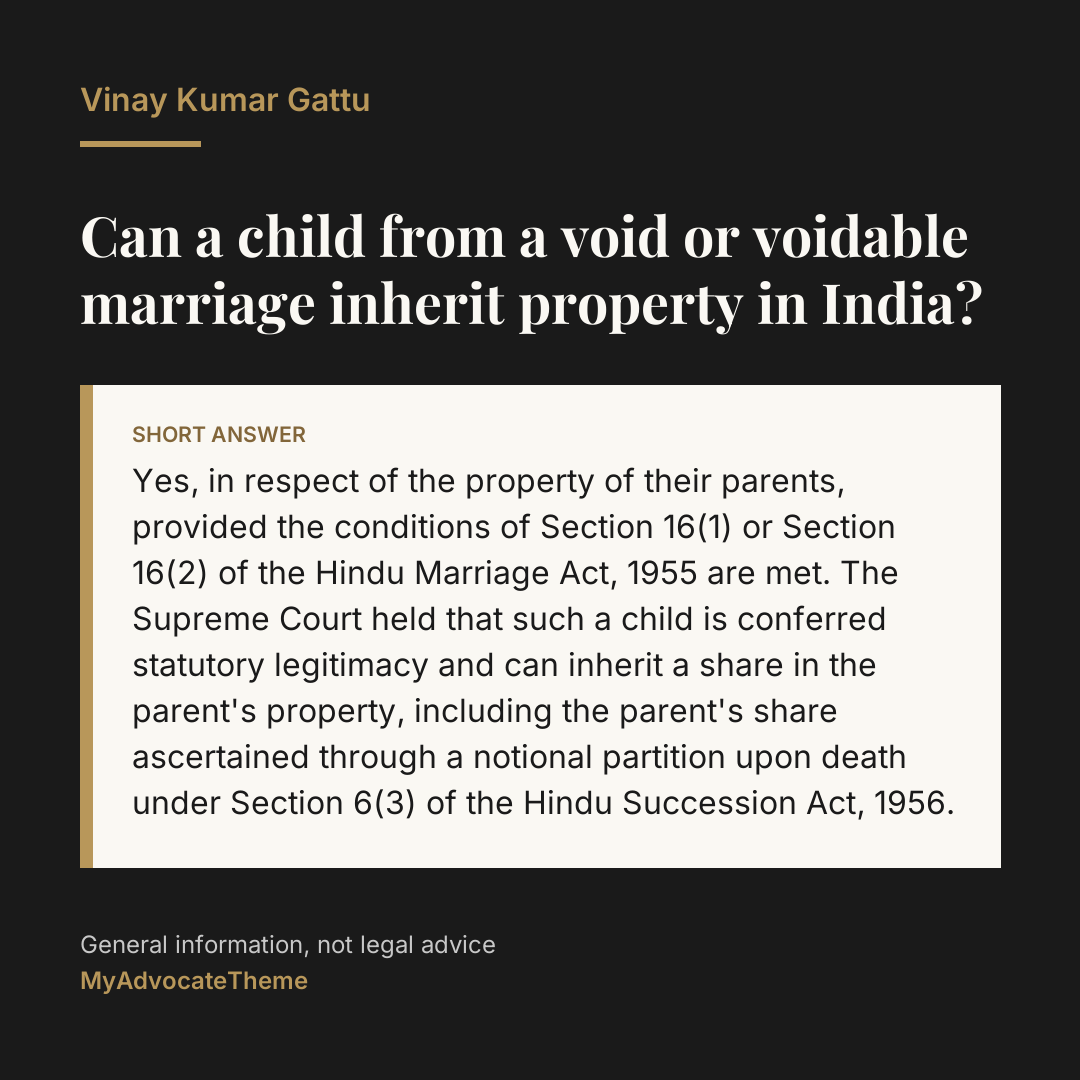
Can a child from a void or voidable marriage inherit property in India?

Yes, in respect of the property of their parents, provided the conditions of Section 16(1) or Section 16(2) of the Hindu Marriage Act, 1955 are met. The Supreme Court held that such a child is conferred statutory legitimacy and can inherit a share in the parent's property, including the parent's share ascertained through a notional partition upon death under Section 6(3) of the Hindu Succession Act, 1956.

Showing 15 of 15 questions

How the Consultation Process Works

  1. Confidential Case Evaluation

    Share your documents and background details. I conduct an initial review to understand the factual and legal posture of your matter.

  2. Strategic Roadmap & Opinion

    Receive a clear, honest assessment of your legal remedies, potential risks, timelines, and the exact course of action required.

  3. Dedicated Execution & Representation

    From meticulous drafting of pleadings and legal notices to focused advocacy in court, your matter is handled with thorough preparation.

Book a Consultation

Get the latest updates & legal knowledge

New articles, important court judgments and practical legal tips, explained in simple language and sent to you on WhatsApp.