More languages

Machine translation by Google, for convenience only. It may contain errors; the English and Telugu pages are the reliable versions.

Legal Consultation · Vinay Kumar Gattu

Adverse Judgment and Appeal Assessment

A review of a judgment or order passed against you to check whether an appeal, revision, review or writ petition is available – and how much time you have left to file it.

When a judgment goes against you, the clock starts running immediately. Appeals, revisions and reviews must be filed within short, fixed periods, and the right remedy depends on the court that passed the order and the kind of case. This consultation reviews the judgment and tells you what you can do next – and by when.

Is this for you?

  • A civil suit has been decided against you, or a decree has been passed for possession, money or an injunction.
  • You, or a family member, have been convicted, or the accused in your complaint has been acquitted.
  • A single judge of the High Court has dismissed your writ petition.
  • A tribunal, authority or revenue officer has passed an order against you – for example in a service, land or tax matter.
  • The time to appeal may already have passed, and you want to know whether the delay can be condoned.

Time limits are short

Some common examples under the Limitation Act and court rules (the exact period depends on the case, so always check yours):

  • Appeal to the High Court from a civil decree: 90 days; appeal to a District Court: 30 days.
  • Appeal against a conviction to the High Court: 60 days; to any other court: 30 days.
  • Writ appeal against a single judge’s order in the High Court: generally 30 days.
  • Review of a judgment: generally 30 days; Special Leave Petition to the Supreme Court: 90 days.

Time taken to obtain a certified copy of the judgment is usually excluded, so apply for it at once. If the period has passed, an application for condonation of delay (Section 5 of the Limitation Act) can be considered, but you must explain the delay with reasons and supporting material.

What you get

  • A reading of the judgment to identify errors of fact or law that an appeal court can correct.
  • The right remedy: appeal, revision, review, writ petition or Special Leave Petition.
  • The limitation period that applies to you and the date by which you must file.
  • Whether a stay of the judgment or its execution can be sought meanwhile.
  • If you are late, an assessment of whether condonation of delay is realistic.

What to keep ready

  • The judgment or order (a certified copy if you have one), and the date it was pronounced.
  • The date you applied for and received the certified copy.
  • The pleadings and key evidence from the case, if available.
How it works

  1. Book a time

    Choose the length, a date and a time online, and pay securely. Consultations are by phone call / video call; in-person meetings at the office in Dilsukhnagar, Hyderabad, can be arranged.

  2. Share your documents

    Send copies of the papers and a short summary of your matter at least 48 hours before, so the time is spent on your questions, not on reading.

  3. Get clear answers

    You hear where you stand, your options and the realistic next steps, in English or Telugu. Everything you share is kept confidential.

Book a Consultation

Who you will speak to

Vinay Kumar Gattu, Advocate

Practises before
High Court for the State of Telangana
Enrolled with
Bar Council of Telangana
Education
Bachelor of Laws (LL.B., 3-year course), Osmania University; Master of Computer Applications (M.C.A.), Osmania University; Bachelor of Science (B.Sc.), Kakatiya University
Languages
English, Telugu

More about me

Frequently asked questions

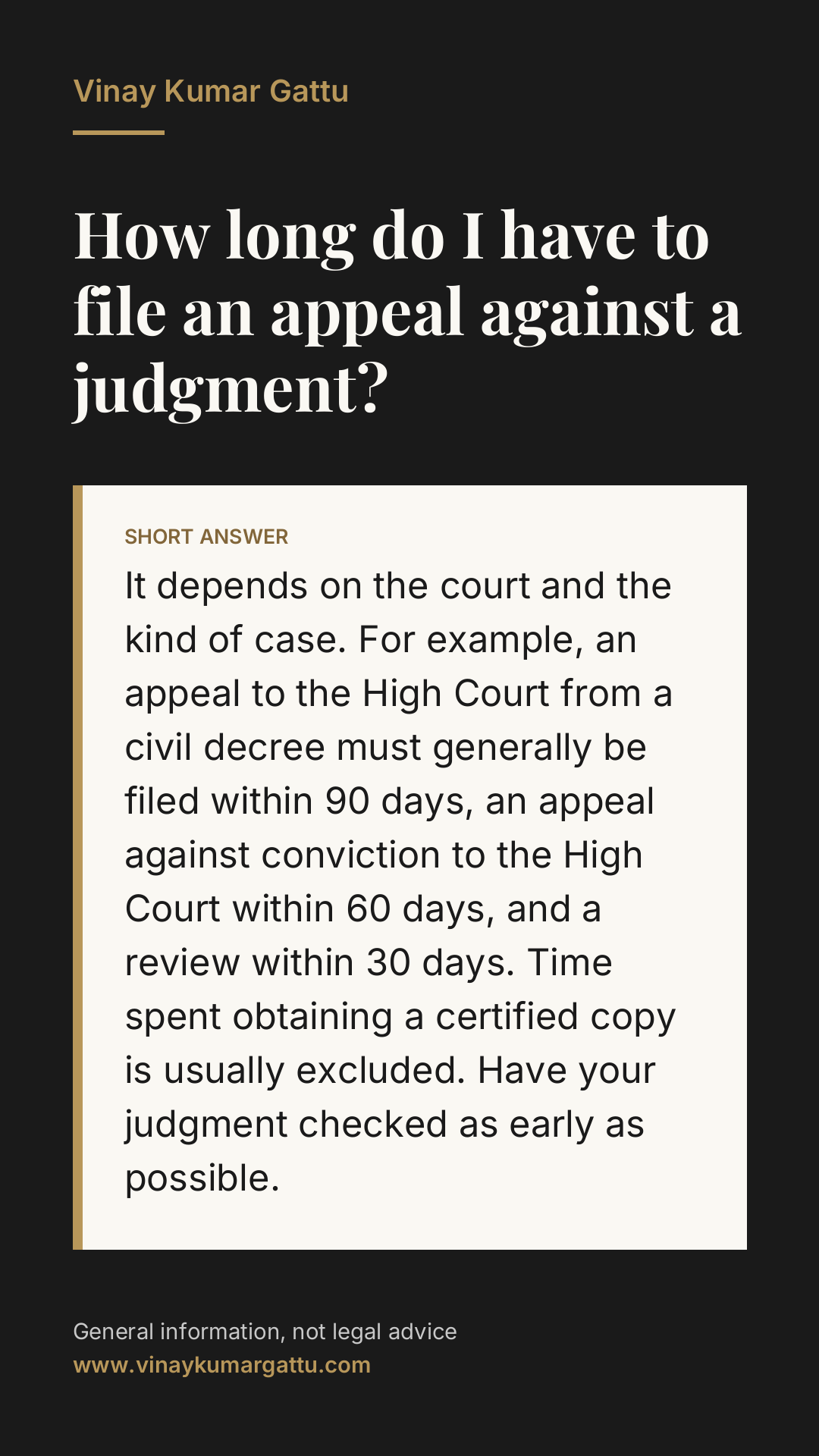
  1. How long do I have to file an appeal against a judgment?

    It depends on the court and the kind of case. For example, an appeal to the High Court from a civil decree must generally be filed within 90 days, an appeal against conviction to the High Court within 60 days, and a review within 30 days. Time spent obtaining a certified copy is usually excluded. Have your judgment checked as early as possible.

    Constitutional & Writ Litigation

  2. The appeal period is over. Is there anything I can do?

    An appeal can still be filed with an application for condonation of delay under Section 5 of the Limitation Act. The court must be satisfied there was sufficient cause for the delay, so the reasons need to be explained clearly and supported.

    Constitutional & Writ Litigation

  3. What is the difference between an appeal, a revision and a review?

    An appeal is a fresh look at the case by a higher court. A revision lets a higher court correct jurisdictional or legal errors where no appeal lies. A review asks the same court to reconsider its own judgment for an error apparent on the record or new evidence.

    Constitutional & Writ Litigation

  4. Can the judgment be stopped from being enforced while I appeal?

    Filing an appeal does not by itself stop enforcement. A separate application for stay of the judgment or its execution can be made, and the court decides it on the facts.

    Constitutional & Writ Litigation

  5. What is a certified copy and why do I need it?

    A certified copy is an official copy of the judgment or order issued and attested by the court. It is required for filing an appeal in most cases, and the time taken to obtain it is excluded when counting the limitation period, so apply for it immediately after the judgment.

    Constitutional & Writ Litigation

  6. Can I appeal against an interim order?

    Some interim orders can be appealed directly, such as certain orders on temporary injunctions listed in Order 43 of the Code of Civil Procedure. Others can only be challenged by revision or a writ petition, or along with the appeal against the final judgment.

    Constitutional & Writ Litigation

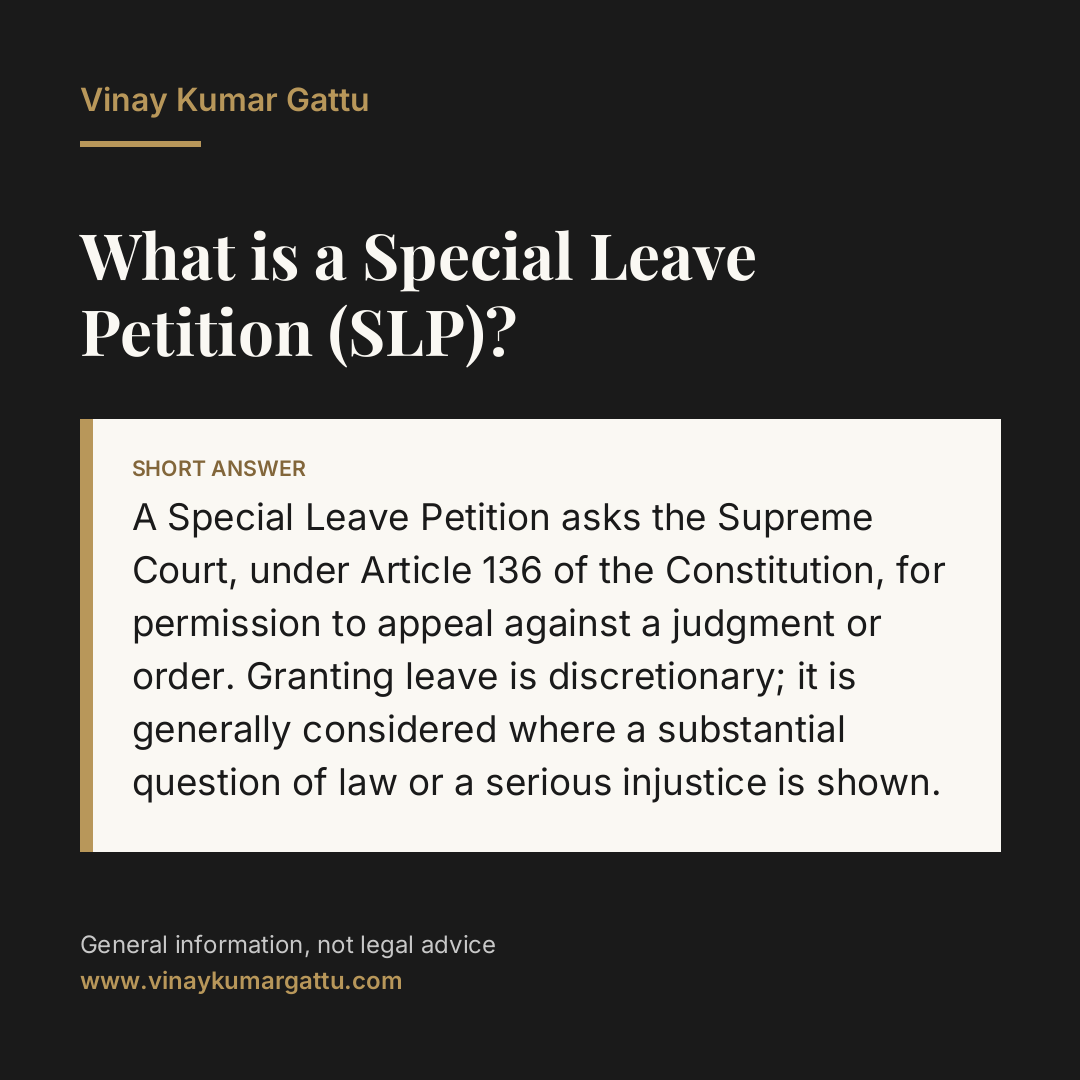
  7. What is a Special Leave Petition (SLP)?

    A Special Leave Petition asks the Supreme Court, under Article 136 of the Constitution, for permission to appeal against a judgment or order. Granting leave is discretionary; it is generally considered where a substantial question of law or a serious injustice is shown.

    Constitutional & Writ Litigation

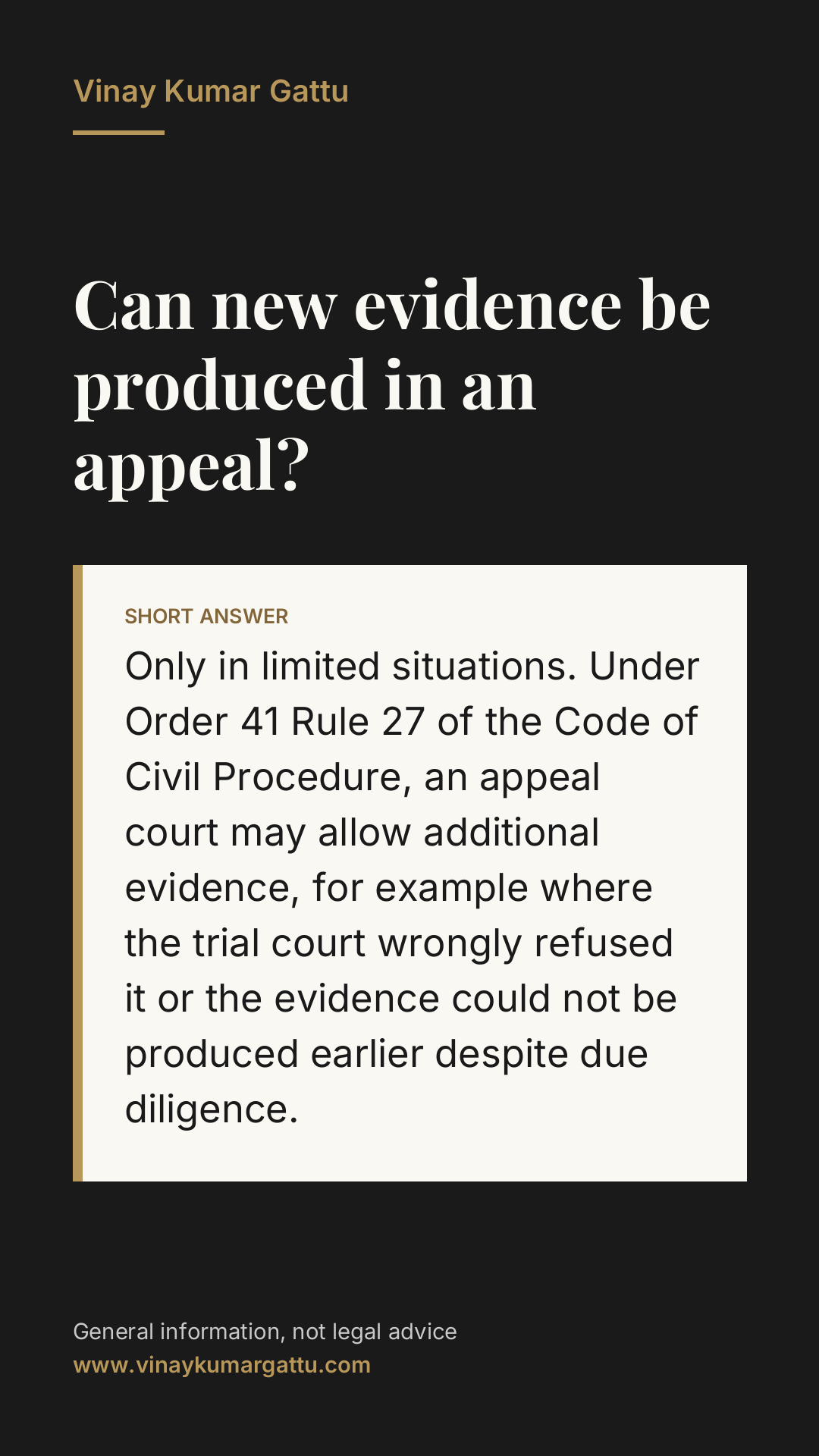
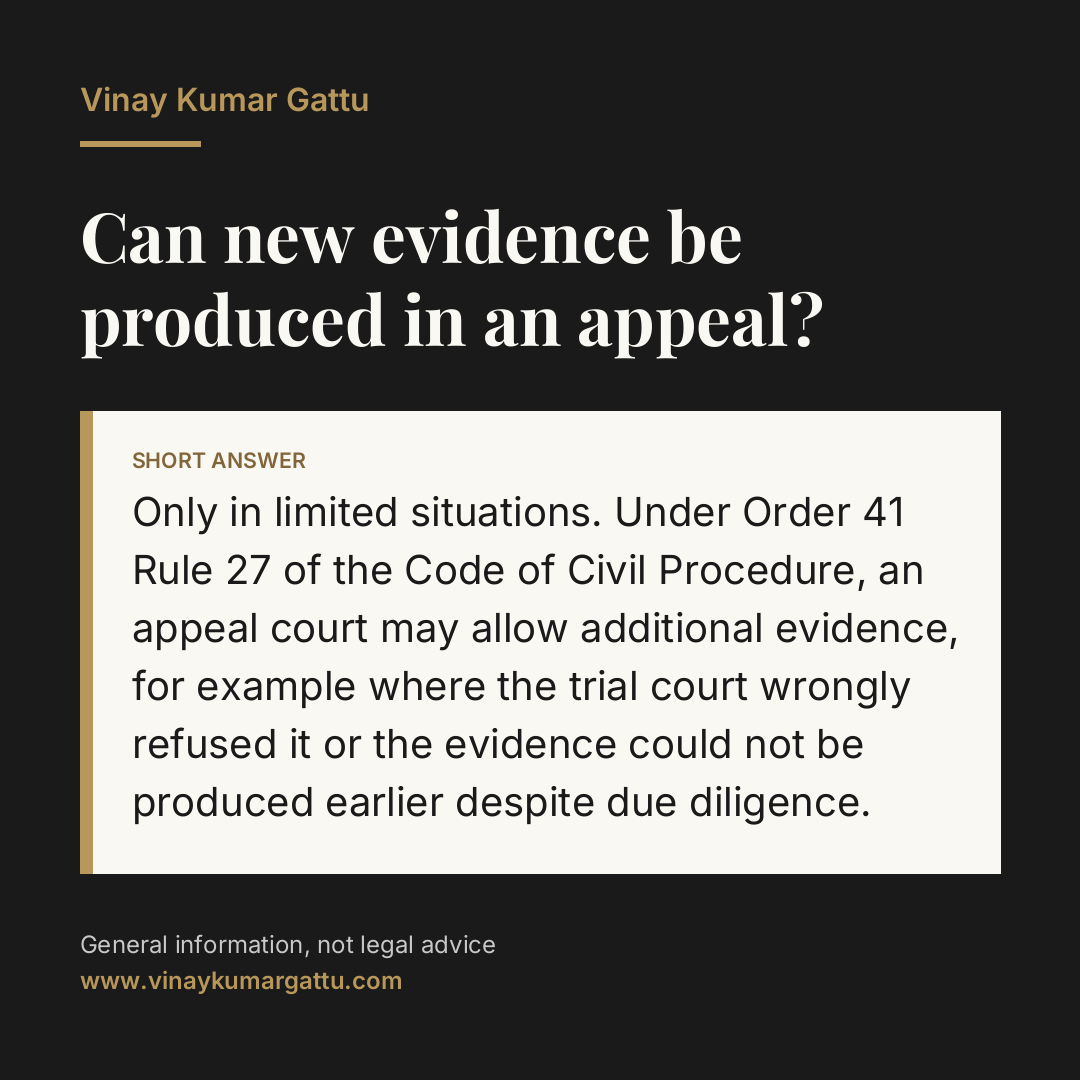
  8. Can new evidence be produced in an appeal?

    Only in limited situations. Under Order 41 Rule 27 of the Code of Civil Procedure, an appeal court may allow additional evidence, for example where the trial court wrongly refused it or the evidence could not be produced earlier despite due diligence.

    Constitutional & Writ Litigation

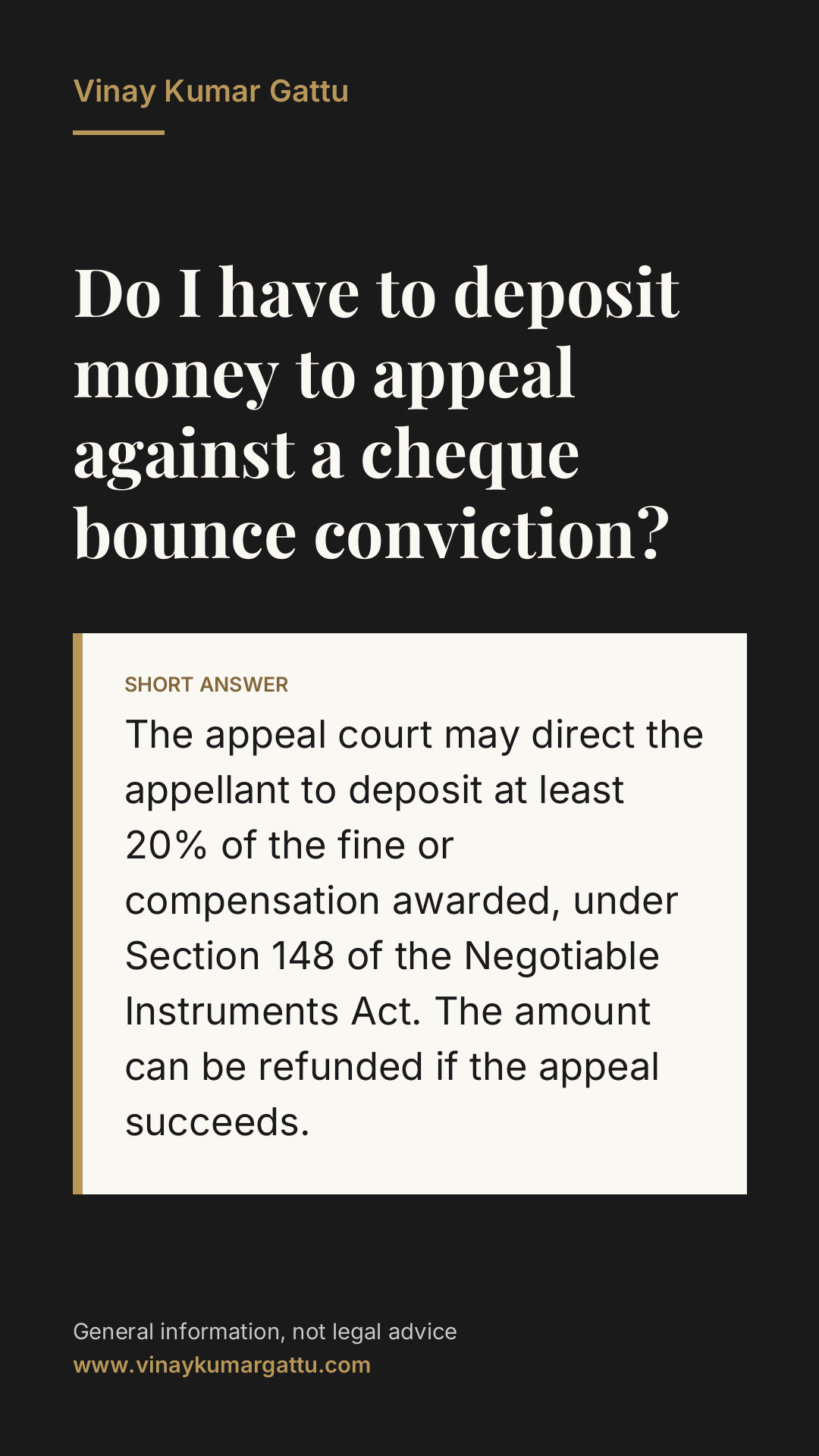
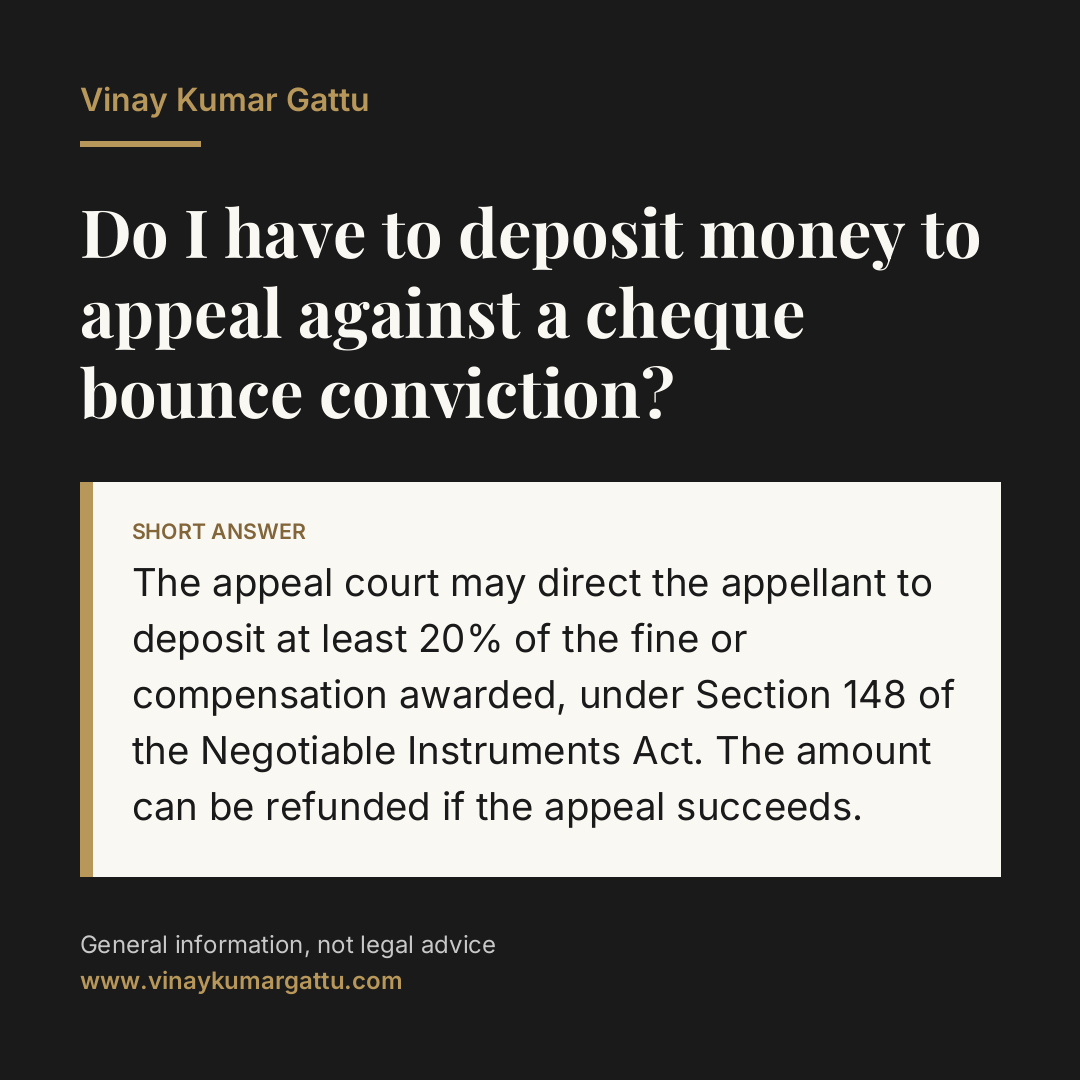
  9. Do I have to deposit money to appeal against a cheque bounce conviction?

    The appeal court may direct the appellant to deposit at least 20% of the fine or compensation awarded, under Section 148 of the Negotiable Instruments Act. The amount can be refunded if the appeal succeeds.

    Criminal Defense, Bail & Quash Petitions

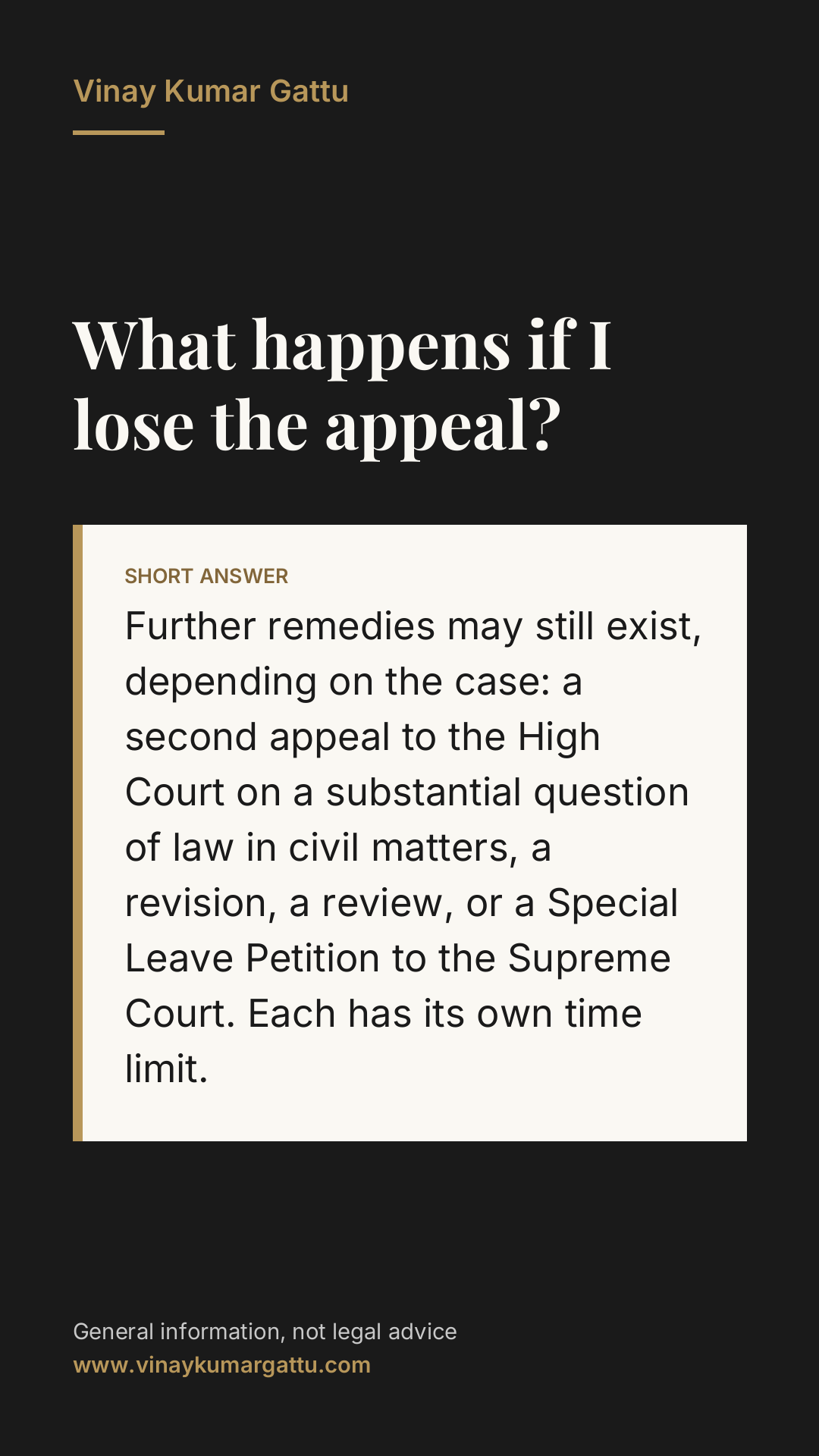
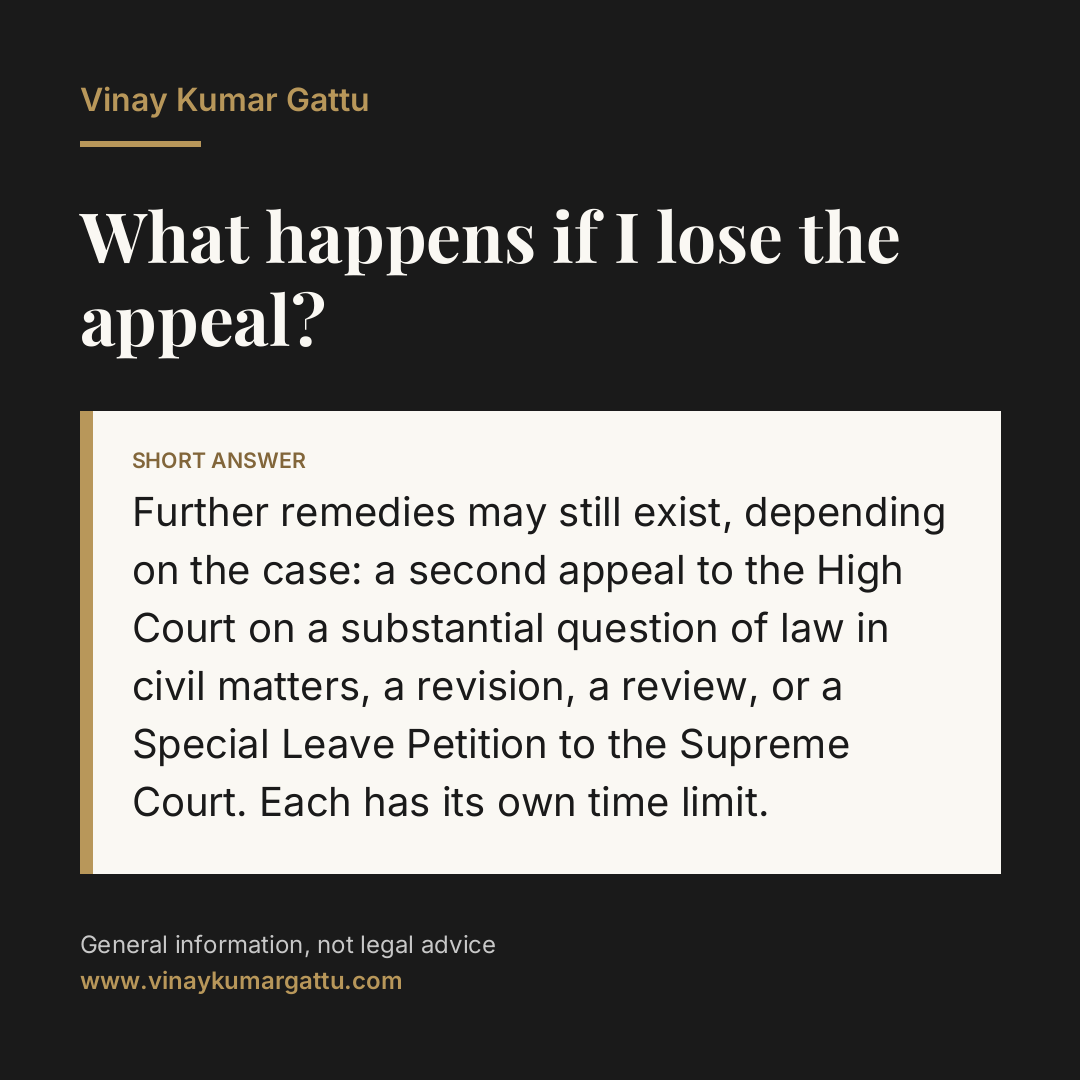
  10. What happens if I lose the appeal?

    Further remedies may still exist, depending on the case: a second appeal to the High Court on a substantial question of law in civil matters, a revision, a review, or a Special Leave Petition to the Supreme Court. Each has its own time limit.

    Constitutional & Writ Litigation

Ready to discuss your matter?

Book a time online or send a WhatsApp message. Mention briefly what your matter is about, so the first conversation can go straight to it.

This page gives general information about a consultation service; it is not legal advice.

Get the latest updates & legal knowledge

New articles, important court judgments and practical legal tips, explained in simple language and sent to you on WhatsApp.

This form is protected by reCAPTCHA. Google's Privacy Policy and Terms of Service apply.